

Human Augmentation Market Expands from US$ 345.2 Bn to US$ 1,326.3 Bn | Persistence Market Research
Human Augmentation Market
The human augmentation market is growing rapidly, driven by advancements in wearable devices, robotics, and AI, with increasing demand in healthcare, defense..
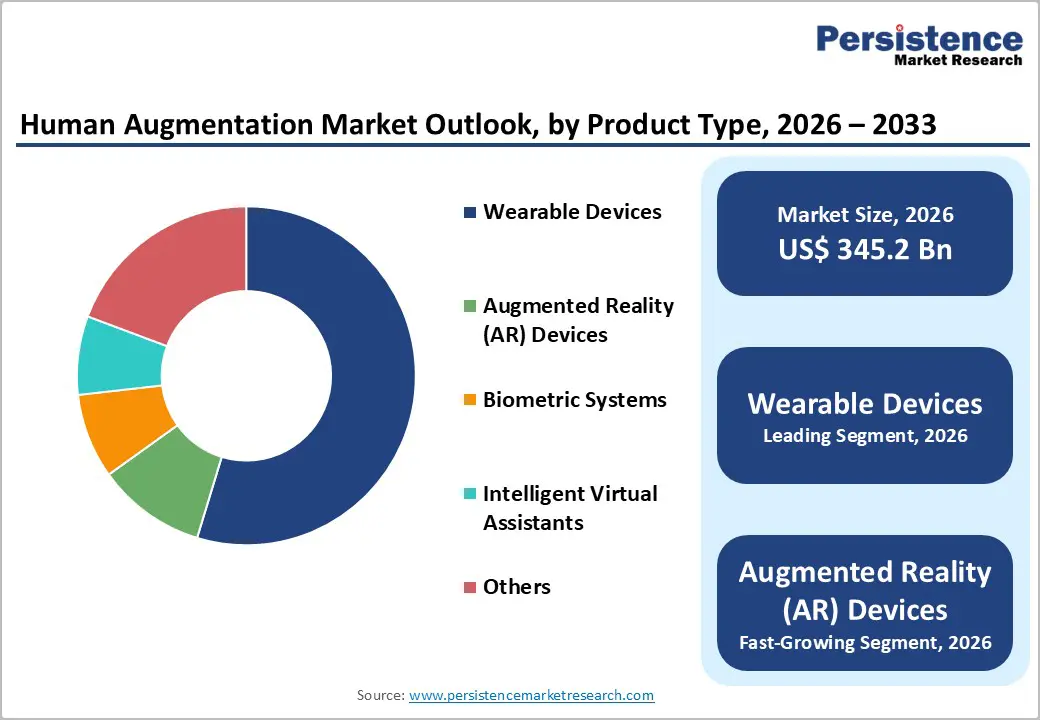
LONDON, UNITED KINGDOM, February 11, 2026 /EINPresswire.com/ -- The global human augmentation market is set to experience substantial growth, projected to expand from USD 345.2 billion in 2026 to USD 1,326.3 billion by 2033, reflecting a compound annual growth rate (CAGR) of 21.2% during the forecast period. This rapid growth is driven by aging populations, increasing workforce productivity needs, rehabilitation demands, and advancements in wearables, exoskeletons, and neurotechnology.
Download Your Free Sample & Explore Key Insights: https://www.persistencemarketresearch.com/samples/4463
Market Drivers and Key Factors Behind Growth
Several factors are fueling the expansion of the human augmentation market. One of the primary drivers is the increasing aging population worldwide, which is prompting greater demand for mobility support, healthcare innovations, and rehabilitation technologies. Additionally, the need to enhance workforce productivity and reduce injury rates is encouraging industrial sectors to adopt human augmentation systems, such as exoskeletons and wearable devices, to improve safety and performance.
The healthcare sector’s demand for rehabilitation technologies, such as prosthetics and powered exoskeletons, is another key market driver. Furthermore, rapid advancements in robotics, artificial intelligence (AI), and neurotechnology are expanding the scope of human augmentation technologies, improving performance across industries like defense, healthcare, and manufacturing.
Regional Insights and Trends
North America is currently the largest market for human augmentation, holding a 40.3% market share in 2025. This dominance can be attributed to strong healthcare infrastructure, substantial defense spending, and early adoption of augmentation technologies. The U.S. government, through agencies like the Department of Veterans Affairs and the National Institutes of Health (NIH), continues to invest heavily in research and development in this space. Moreover, the country’s aging population—over 13% of U.S. adults experience mobility disabilities—creates significant demand for assistive devices, which fuels the market for wearable technologies and prosthetics.
The Asia-Pacific region is the fastest-growing market, driven by rapid industrialization, an aging population, and increased healthcare access. Countries like China, Japan, and South Korea are experiencing a surge in demand for wearable devices, powered exoskeletons, and assistive robotics to address the needs of their aging populations and expand healthcare options.
Get Custom Insights Designed for Your Business: https://www.persistencemarketresearch.com/request-customization/4463
Key Product Segments in Human Augmentation
The wearable devices segment is set to dominate the human augmentation market, accounting for 54.7% of the market share in 2025. This is primarily due to the widespread adoption of devices like exoskeletons, smart prosthetics, augmented reality (AR) wearables, and sensor-based augmentation systems, which are used in healthcare, defense, industrial, and rehabilitation sectors. These devices enhance mobility, improve real-time performance, and provide ongoing support for physical tasks.
Monitors, including health trackers, fitness trackers, and smartwatches, will continue to capture a significant portion of the market. According to the International Data Corporation (IDC), global shipments of wearable devices exceeded 537.9 million units in 2024, demonstrating the widespread adoption and utility of non-invasive, body-worn devices.
Technological Advancements and Opportunities
Technological advancements in artificial intelligence (AI), robotics, and neurointerfaces are opening new opportunities in human augmentation. AI integration with wearable devices is improving real-time performance monitoring and enabling better healthcare outcomes. Neurointerfaces and brain-computer interfaces are increasingly explored for their potential in rehabilitation, offering innovative solutions for neurological disorders and spinal cord injuries.
Additionally, the market for powered exoskeletons, especially in rehabilitation and elderly care, is growing rapidly. These devices are helping patients regain mobility and improving rehabilitation outcomes by offering support in walking, standing, and performing other physical tasks. Lightweight, cost-effective exoskeletons are seen as a significant area for growth as healthcare providers and patients seek more affordable and practical solutions.
Challenges in the Human Augmentation Market
Despite promising growth prospects, the human augmentation market faces several challenges. One of the major obstacles is the high cost of advanced augmentation systems. For instance, prosthetics in the U.S. can cost between USD 15,000 and USD 90,000, and powered exoskeletons can range from USD 40,000 to USD 120,000 per unit. This high price point limits accessibility, particularly for patients without adequate insurance coverage. Additionally, smaller healthcare providers, especially in emerging economies, struggle to integrate advanced augmentation technologies due to financial constraints.
Another challenge is the regulatory environment. Many advanced augmentation technologies, such as brain-computer interfaces and medical-grade exoskeletons, face lengthy approval processes and complex regulatory requirements, which can slow down innovation and market adoption.
Competitive Landscape and Key Players
The human augmentation market is highly competitive, with numerous global and regional players driving innovation across wearable, portable, and stationary systems. Major companies in the market include Google LLC (Alphabet Inc.), ReWalk Robotics Ltd., Sony Corporation, Microsoft Corporation, and Ekso Bionics Holdings, Inc. These companies are investing heavily in research and development to create next-generation technologies that offer enhanced functionality, safety, and efficiency.
In December 2025, Google partnered with eyewear brands, including Warby Parker, to develop AI-powered smart glasses, marking a significant move into wearable AI devices. Similarly, in January 2024, Sony announced the development of a spatial content creation system that includes high-quality XR head-mounted displays, showcasing the company's push into human augmentation through immersive technologies.
Checkout Now & Download Complete Market Report: https://www.persistencemarketresearch.com/checkout/4463
Human Augmentation Market Segmentation
By Product Type
Wearable Devices
Augmented Reality (AR) Devices
Biometric Systems
Intelligent Virtual Assistants
Others
By Functionality
Body Worn
Non-body Worn
By Technology
Wearable
Virtual Reality
Augmented Reality
Exoskeleton
Intelligent Virtual Assistants
By End User
Consumer
Commercial
Medical
Defense
Industrial
Others
By Region
North America
Europe
East Asia
South Asia & Oceania
Latin America
Middle East and Africa
Read Related Reports:
Mitotane Market: The global mitotane market is valued at US$22.7 million in 2025 and projected to reach US$31.2 million by 2032, growing at a 4.7% CAGR during 2025–2032.
Bioinformatics Services Market: The global bioinformatics services market is valued at USD 4.2 B in 2025 and projected to reach USD 11.5 B by 2032, growing at a 16.1% CAGR (2025–2032).
Persistence Market Research
Persistence Market Research Pvt Ltd
+1 646-878-6329
email us here
Visit us on social media:
LinkedIn
Instagram
Facebook
YouTube
X
Legal Disclaimer:
EIN Presswire provides this news content "as is" without warranty of any kind. We do not accept any responsibility or liability for the accuracy, content, images, videos, licenses, completeness, legality, or reliability of the information contained in this article. If you have any complaints or copyright issues related to this article, kindly contact the author above.
